DOT Insurance Requirements for Trucking Companies
What Coverage Do You Need?
Understanding DOT insurance requirements is essential for starting and operating a compliant trucking business. Whether you are applying for new motor carrier authority, adding trucks to an existing fleet, transporting hazardous materials, or signing a contract with a new broker, the insurance you carry can directly affect your ability to operate.
Federal insurance requirements are based on several factors, including your operating authority, vehicle size, cargo type, and whether you transport property or passengers. State requirements, shipper contracts, broker agreements, and equipment financing terms may require additional protection beyond the federal minimum.
RJS Truck Insurance helps owner-operators, new authorities, and established fleets evaluate these requirements and build coverage around their actual operations.
What Are DOT Insurance Requirements?
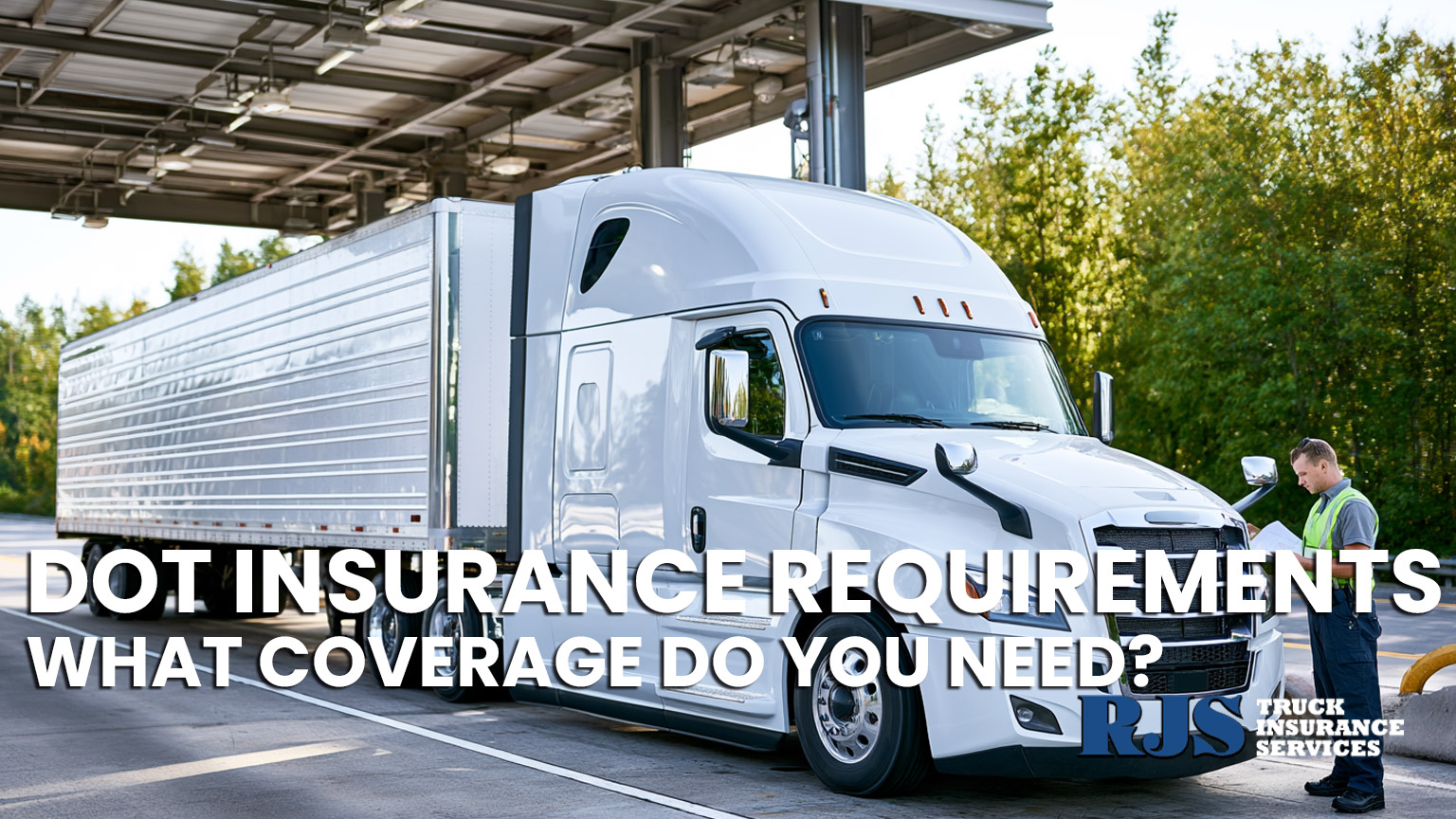
The term “DOT insurance requirements” generally refers to the minimum financial responsibility standards that commercial motor carriers must meet under federal and state transportation regulations.
For interstate carriers under Federal Motor Carrier Safety Administration jurisdiction, 49 CFR Part 387 establishes minimum financial responsibility levels for certain property and passenger carriers.
The insurance requirement for your company may depend on:
- Whether you operate interstate or intrastate
- Your vehicle’s gross vehicle weight rating
- Whether you operate for hire
- The type of property or passengers you transport
- Whether you haul hazardous materials
- Your operating authority classification
- Additional state or contractual requirements
Meeting the federal minimum does not necessarily mean your business has enough insurance to handle every serious claim. Many trucking companies purchase higher limits or additional policies to protect their equipment, cargo, revenue, and long-term financial stability.
Minimum Commercial Auto Liability Requirements
Primary auto liability, sometimes called public liability insurance, is the foundation of most commercial trucking insurance programs. It covers bodily injury and property damage for which the motor carrier is legally responsible.
For many for-hire interstate property carriers operating vehicles weighing 10,001 pounds or more, the federal minimum is $750,000. Certain hazardous commodities require higher limits.
Depending on the materials transported, hazardous-material carriers may need $1 million or $5 million in public liability coverage. The exact requirement depends on the commodity, quantity, packaging, and transportation method.
Although $750,000 may satisfy the federal minimum for many operations, brokers and shippers commonly require a $1 million auto liability limit before awarding loads. Higher limits may also be appropriate when hauling high-risk commodities or operating in areas with greater accident exposure.
FMCSA Insurance Filings and Operating Authority
Purchasing a policy is only one part of satisfying federal requirements. When a motor carrier applies for operating authority, its insurance company generally must submit proof of coverage electronically to the FMCSA.
Forms BMC-91 or BMC-91X are used to provide proof of bodily injury and property damage liability insurance. These filings are submitted by the insurance company or an authorized electronic filer—not by the trucking company itself.
The legal name, address, and motor carrier information on your insurance filing must match your FMCSA registration. Inconsistent information can delay the activation of your operating authority.
The MCS-90 endorsement is also required for motor carrier policies subject to federal financial responsibility regulations. It is designed to assure payment for certain public liability claims up to the applicable federal limit. It should not be treated as a substitute for properly structured insurance coverage.
RJS works with new trucking ventures and can assist with filing support, coverage selection, and obtaining proof of insurance when authority activation deadlines are approaching. RJS states that its agents help new authorities through DOT filings and can typically provide a quote within one to two business days.
Is Motor Truck Cargo Insurance Required?
Motor truck cargo insurance protects the freight entrusted to your care, custody, and control. It may help pay for covered cargo that is damaged, stolen, lost, or destroyed in transit.
Federal cargo filings are specifically required for certain household goods carriers. Other property carriers may not have a general federal cargo-insurance mandate, but cargo coverage is frequently required by brokers, shippers, customers, and transportation contracts. FMCSA identifies Form BMC-34 as a cargo liability filing used for household goods carriers.
Common cargo limits include $100,000, although the right limit depends on what you haul. Refrigerated goods, automobiles, electronics, machinery, produce, building materials, and other specialized freight may require different limits or endorsements.
Policy exclusions also matter. Ask whether your policy addresses unattended vehicles, theft, water damage, temperature changes, loading and unloading, debris removal, earned freight charges, and reefer breakdown.
RJS offers motor truck cargo coverage and notes that reefer breakdown coverage may be automatically included in certain carrier-dependent package options.
Physical Damage Coverage
Physical damage insurance protects the insured tractor, trailer, or other scheduled equipment against covered losses. It typically includes collision coverage and comprehensive or specified-causes-of-loss protection.
Physical damage coverage is not generally an FMCSA operating-authority requirement. However, a lender or leasing company will usually require it when equipment is financed or leased.
Even when the truck is paid off, operating without physical damage coverage can expose your company to a substantial replacement or repair expense. Towing, downtime, glass damage, theft, vandalism, fire, and weather-related losses should all be considered when designing the policy.
RJS offers commercial truck insurance options that may combine liability, physical damage, cargo, and general liability under one policy, depending on carrier and policy eligibility. Certain programs may also offer a single deductible for covered cargo and physical damage losses.
General Liability and Other Important Coverages
Commercial auto liability does not cover every risk a trucking company faces. General liability insurance may provide protection for covered claims arising from business activities that are not directly caused by operation of a covered vehicle.
Examples may include:
- Customer injuries at your business location
- Certain loading or unloading incidents
- Property damage arising from covered business operations
- Some contractual or premises-related exposures
Additional coverage options may include:
Trailer interchange insurance
-
Covers certain physical damage to non-owned trailers in your possession under a trailer interchange agreement.
Workers’ compensation
-
Provides required benefits for eligible employees who experience work-related injuries or occupational illnesses.
Excess or umbrella liability
-
Adds liability limits above underlying policies, subject to policy terms.
Non-trucking liability
-
May protect an owner-operator while using a truck for authorized non-business purposes when permanently leased to a motor carrier.
Occupational accident insurance
-
An alternative coverage option sometimes used for qualifying independent contractors, though it is not the same as workers’ compensation.
Property coverage
- Can protect buildings, office property, tools, and other business assets.
RJS provides options for liability, physical damage, cargo, general liability, excess liability, property coverage, workers’ compensation, and other trucking-related risks.

How Much Truck Insurance Do You Really Need?
Your federal minimum is only the starting point. A well-designed insurance program should consider the value of your equipment, maximum cargo exposure, driving radius, loss history, commodities hauled, contracts, number of vehicles, driver experience, and company structure.
Choosing the lowest limit or cheapest policy without reviewing exclusions can leave serious gaps. The objective should be to obtain competitive coverage that meets regulatory requirements while protecting the assets and revenue your business depends on.
RJS has more than 30 years of commercial trucking insurance experience and works with owner-operators, new ventures, and fleet accounts. Its team can review your operation, explain available options, assist with filings, and identify carrier programs that fit your coverage and payment needs.
The Answer
DOT Insurance Requirements: 5 Common Questions
What is the minimum liability insurance required for a trucking company?
Many for-hire interstate property carriers operating vehicles weighing at least 10,001 pounds must maintain a minimum of $750,000 in public liability coverage. Hazardous-material operations may require $1 million or $5 million.
Do I need $1 million in commercial auto liability coverage?
Federal regulations may require only $750,000 for certain carriers, but many freight brokers, shippers, and contracts require a $1 million limit.
Who files my insurance with the FMCSA?
Your insurance company or an authorized electronic filer submits the required BMC-91 or BMC-91X filing. The motor carrier generally cannot submit its own insurance filing.
Is cargo insurance required to activate my authority?
Most general property carriers are not subject to a federal cargo filing requirement, but household goods carriers have specific cargo-filing obligations. Brokers and shippers may still require cargo insurance before allowing you to haul freight.
Can a new trucking company obtain insurance without prior coverage?
Yes. RJS works with new ventures and newly authorized carriers, including companies without prior insurance history, and helps them evaluate competitive coverage options.
Get a Fast, Free Commercial Truck Insurance Quote
Do not let confusing DOT insurance requirements delay your authority or leave your business exposed. RJS Truck Insurance can help you understand your required filings, compare available carrier options, and select protection tailored to your trucks, cargo, drivers, and contracts.
Get a fast, free quote today. Request your quote online or call 1-800-366-0664 to speak with an experienced commercial truck insurance representative.
Insurance requirements and eligibility vary by operation, jurisdiction, carrier, commodity, and policy. Coverage descriptions are general and subject to the terms, conditions, exclusions, and endorsements of the issued policy.
Get a Free, no-obligation quote today!
Fill out the form below to get the process started.